
Why Packaging Data Is the Real Export Challenge

Australian exporters are facing a growing list of packaging and disclosure requirements, primarily:
- APCO reporting
- UK packaging extended producer responsibility (pEPR)
- The EU Packaging and Packaging Waste Regulation (PPWR)
US state extended producer responsibility (EPR) - Scope 3 emissions reporting and digital product passports each bring their own rules, formats and timelines.
For the teams responsible, the repeated operational task is familiar: identify packaging components, confirm materials and weights, understand packaging levels, assess recyclability and connect the data to volumes sold in each market.
When that information sits across supplier emails, specifications and spreadsheets, every new scheme becomes another collection project. Capturing the data once at component level creates a reusable base for each market.
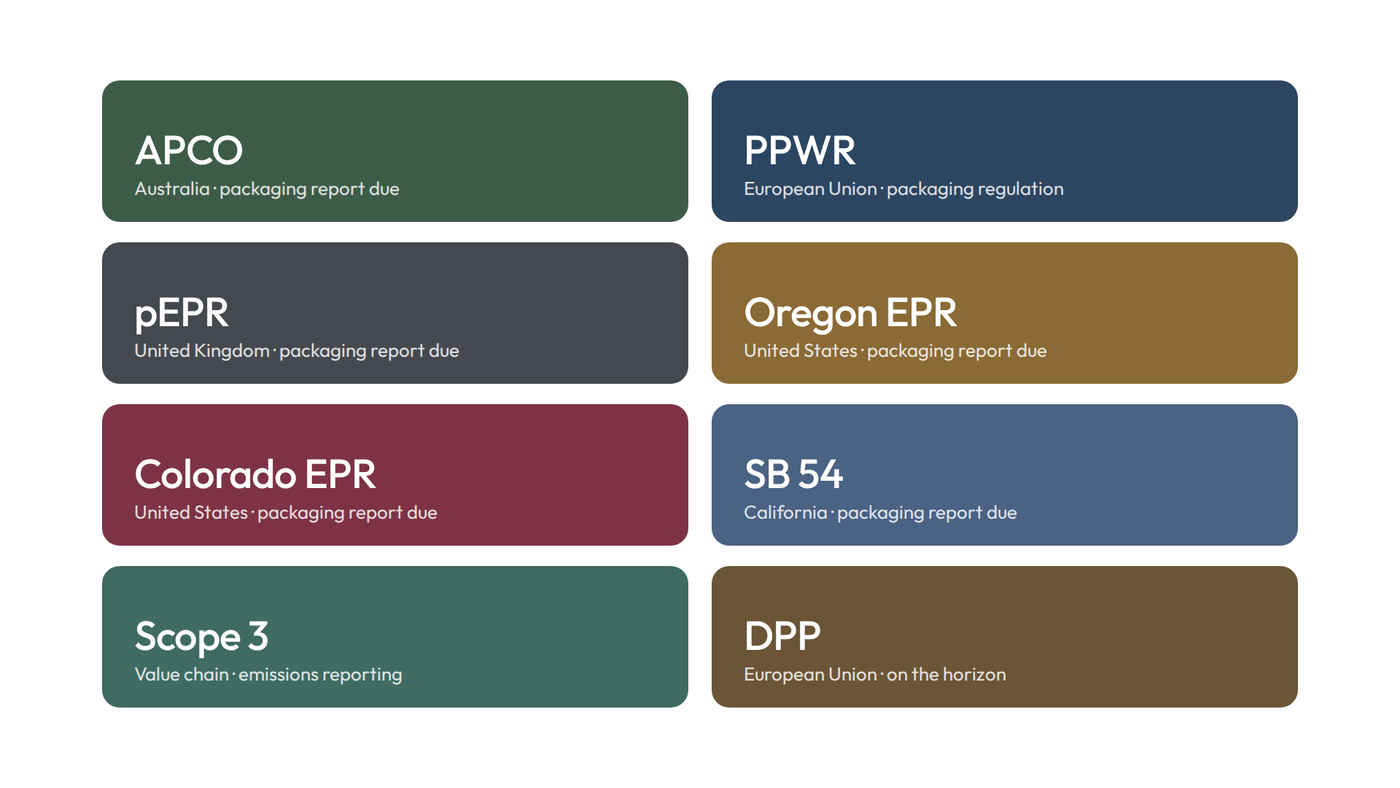
Regulated markets keep asking for the same packaging data
The regulatory calendar is already moving:
- The EU PPWR has applied since 12 August 2026, including to non-EU exporters. Labelling rules follow in 2028 and recyclability rules in 2030.
- UK pEPR Year 2 fees are modulated red, amber and green according to recyclability. Red is charged at 1.2 times amber, and Year 2 fees are based on packaging placed on the market in 2025.
- APCO reports are due on 31 March.
- US state EPR requirements add further reporting routes for exporters selling into those markets.
Each scheme has its own scope and submission format. The underlying information overlaps substantially:
- Packaging materials and component weights
- Primary, secondary and tertiary packaging levels
- Recyclability classifications
- Product and packaging relationships
- Volumes placed on each market
What's needed to manage this kind of complexity and volume is a structured packaging-data library that can feed several obligations. Teams still need to understand each scheme, but they can stop rebuilding the underlying record for every report.
Four lessons from real packaging-data programmes
Structure records around shared components
For example, a meat exporter has around 100 SKUs that share one packaging set and are sold by the kilo. Recreating that packaging record for every SKU would duplicate work and make updates harder to control. A component-level record allows the business to maintain the shared packaging once and connect it to every relevant product.
The same principle applies to more complex packaging hierarchies. One packaging distributor needs to represent nested levels from the tape core through to a bag of six and a carton of 48. Capturing those relationships clearly is essential for accurate totals and market reporting.
Phantm’s BOM Builder and Component Catalogue are in development to support this approach, allowing one packaging component or set to be applied across many SKUs.
Connect supplier collection to an existing business trigger
As another illustrative example, a homewares retailer replaced a manual request, chase and consolidate cycle with a purchase-order-triggered workflow across 15 suppliers. The purchase order provides a clear point to request information while the supplier and product details are current.
Supplier response also improves when the request is clear, made once and easy to complete. Much of the required detail may already exist in finished-goods specifications, so the collection process should identify existing records before asking suppliers to recreate them. Our guide to collecting and validating packaging data from suppliers explains this workflow in more detail.
Track the status and assign ownership
A packaging value can move through several quality states, from AI estimated to supplier validated and customer confirmed. Recording that progression shows teams which figures are ready for reporting and which still need attention.
Ownership is equally important. Procurement may hold the supplier relationship, product or quality teams may own finished-goods specifications, sustainability may interpret reporting needs, and finance or commercial teams may hold market-volume data. A shared system needs a clear owner for each input and decision. As we explored in The same packaging data, four different decisions, one dataset becomes infinitely more useful when every team can see its responsibilities and next action.
Capture once, comply everywhere
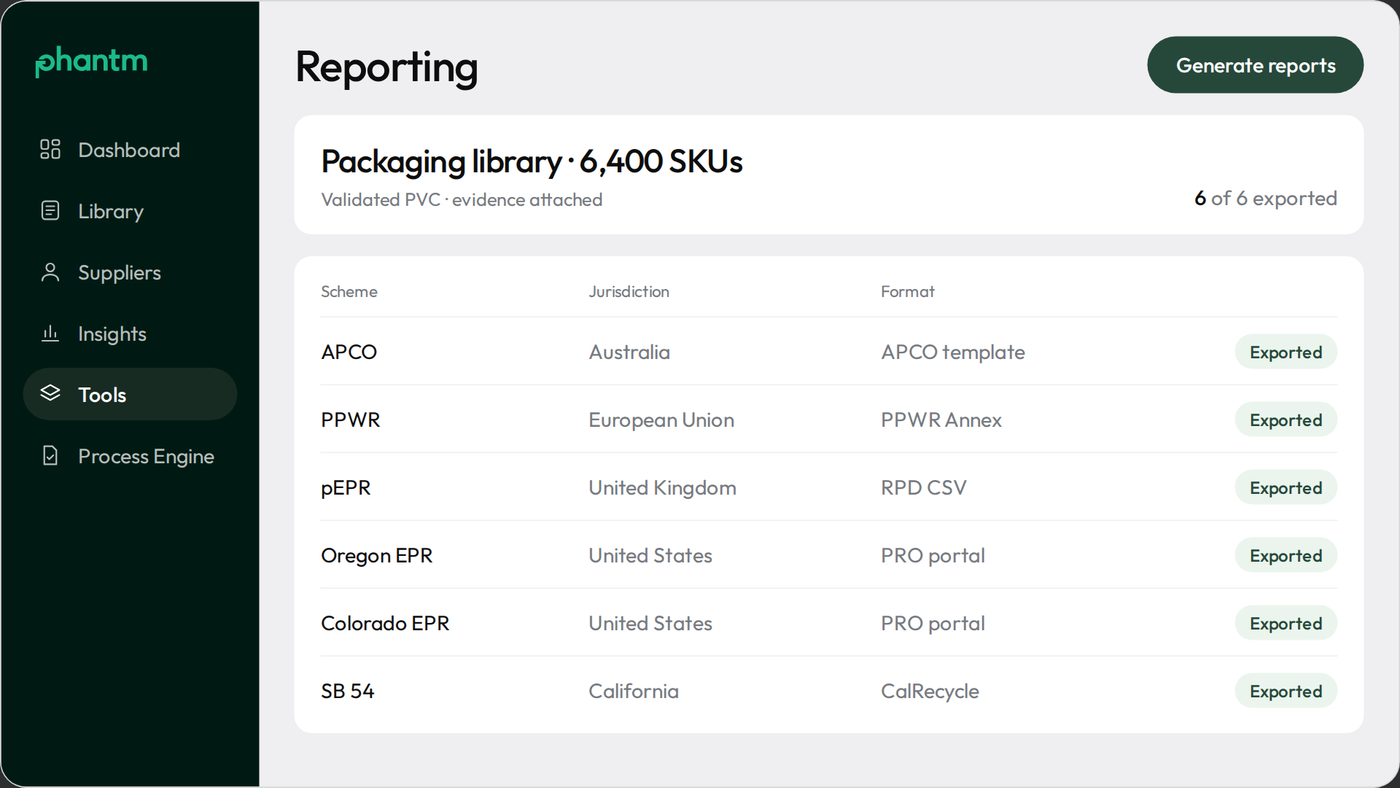
Once component records are connected to products and market volumes, the same library can support exports for APCO, PPWR, UK RPD, US producer responsibility organisation portals and CalRecycle.
Phantm is also developing year-on-year records so each reporting period is preserved. That history will help teams explain changes in packaging, sales volumes and data quality without overwriting the evidence behind an earlier submission.
For exporters, readiness starts with control of the underlying facts. A reusable component-level library reduces repeated collection work and gives every market submission a consistent foundation.
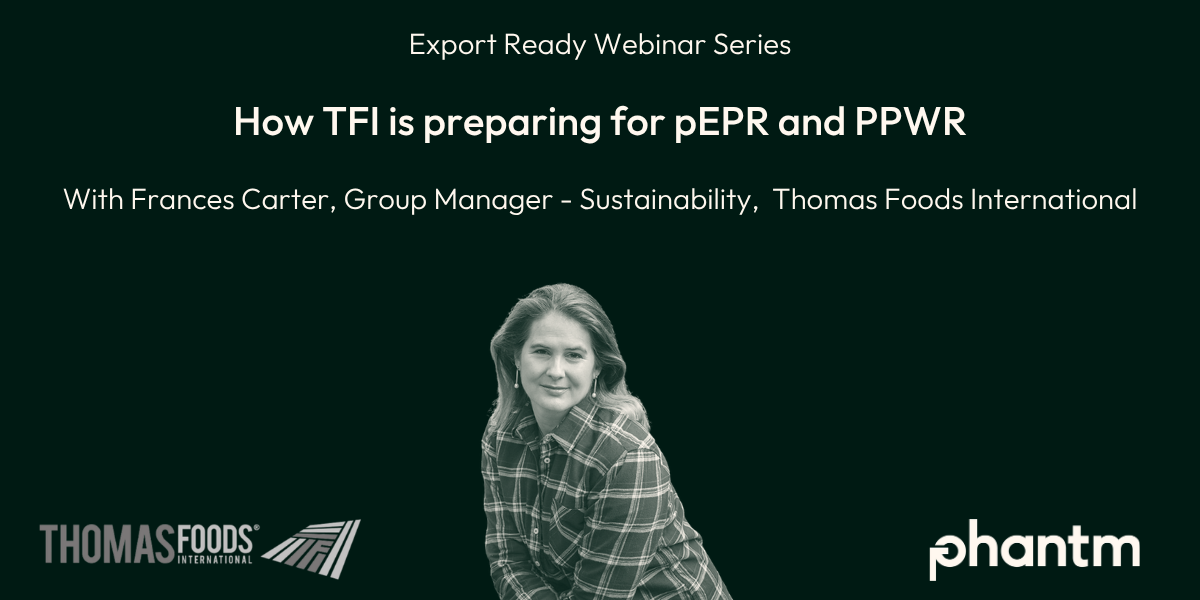
See how TFI is preparing for pEPR and PPWR
Join Frances Carter, Group Manager – Sustainability at Thomas Foods International, for the first free session in Phantm’s Export Ready Webinar Series.
Register for our FREE online webinar, running Wednesday, 11 November 2026, from 12–1 pm AEDT.
See how Phantm structures your packaging data.
Talk to our team to walk through supplier collection, validation and reporting.